Preparing for Your Solar Return Chart: A 4-Step Action Plan
January 26, 2026 | By Seraphina Sterling
Your birthday is more than just a celebration; it’s a personal new year. In astrology, your Solar Return year begins when the Sun returns to the exact position it occupied at your birth. This cosmic event offers a unique astrological blueprint for the next twelve months. But have you ever wondered, what's the next step after getting your chart?
Many people get their solar return readings but find it challenging to apply these insights to daily life. An astrological chart full of potential can easily become just interesting data without a clear strategy. This guide transforms that data into a powerful roadmap. We'll walk you through a practical 4-step action plan to turn your chart into a guide for a year of purpose and growth.
The first step is getting your personalized chart. With our advanced tool, you can instantly generate your chart and get the detailed astrological blueprint you need to start planning.

Step 1: Decoding Your Solar Return Chart's Key Themes
Before you can plan, you need to understand the landscape. Your Solar Return chart highlights specific areas of life and energetic patterns that will be prominent for you. Decoding these key themes is your foundational step. It’s like reading the chapter titles of your personal book for the year ahead.
This chart is a snapshot of the sky at the moment of your solar return, and it sets the tone for the upcoming year. It reveals where your focus will naturally be drawn, what opportunities may arise, and where you might face important lessons. By identifying these patterns early, you can align your actions with the cosmic flow instead of resisting it.
Identifying Dominant Planetary Influences
The planets in your Solar Return chart are the main characters of your year. Pay close attention to the Sun, Moon, and Ascendant sign. The Sun’s house placement shows where you are meant to shine and express your core identity. The Moon’s position reveals your emotional needs and where you'll find comfort. The Ascendant, or rising sign, of the chart colors the year's overall energetic flavor and how you will present yourself to the world.
Look for planets that are strongly placed, such as a planet in the 1st, 10th, 7th, or 4th house (the angular houses). Also, note any stellium—a group of three or more planets in the same house or sign. These areas will demand your attention and energy. For example, a stellium in the 2nd house points to a year focused on finances, values, and self-worth.
Recognizing Critical House Activations
The twelve houses in astrology represent different areas of life, from career and relationships to health and spirituality. Your Solar Return chart will have certain houses "activated" by the presence of important planets. These are the areas where the year's most significant events and developments will unfold.
To identify these, look at which houses contain the Sun, Moon, and the ruler of the Ascendant. For instance, if your Solar Return Sun is in the 7th house, relationships and partnerships will be a central theme. If it's in the 10th house, your career, public reputation, and long-term goals will be in the spotlight. Understanding these activated houses helps you prepare for the themes ahead.
Step 2: Creating Your Monthly Astrological Schedule
Once you understand the major themes of your year, the next step is to break them down into a manageable, month-by-month plan. This is where your annual astrology planning becomes a practical tool for daily life. Instead of just knowing a big theme is coming, you can anticipate when its energy will be strongest.
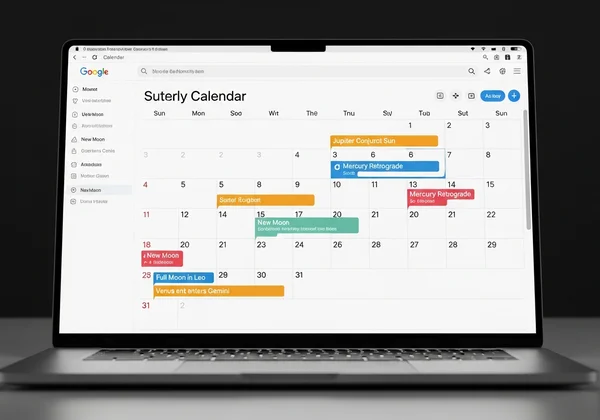
Creating an astrological schedule helps you work with the energy, not against it. You can pinpoint ideal times to launch projects, have important conversations, or take a much-needed rest. This proactive approach turns astrological insights into a strategic advantage for personal and professional growth.
Mapping Planetary Transits to Your Calendar
Transits are the ongoing movements of the planets in the sky. When these transiting planets form aspects (specific angles) to the planets in your Solar Return chart, they trigger events and opportunities. Key transits to watch are from slower-moving planets like Jupiter and Saturn, as their influence is more profound and long-lasting.
For example, note when transiting Jupiter will conjunct, or align with, your Solar Return Sun. This is often a time of great opportunity, confidence, and expansion related to your year's main theme. Conversely, knowing when transiting Saturn will challenge a planet in your chart allows you to prepare for lessons in discipline and responsibility.
Integrating with Digital Tools (Google Calendar, etc.)
In today's world, integrating your astrological schedule with digital tools makes planning seamless. You can add key transit dates, New Moons, and Full Moons directly into your Google Calendar, Outlook, or any other digital planner you use. Set reminders for important astrological events a week or two in advance.
For each entry, you can add a small note: "Jupiter conjuncts SR Venus: Good day for networking & creative projects," or "Mars square SR Saturn: Avoid conflict, focus on patient work." This simple practice keeps your astrological insights top-of-mind and helps you make conscious, aligned decisions throughout the year.
Step 3: Developing Mitigation Strategies for Challenging Aspects
Every year contains both opportunities and challenges. Your Solar Return chart will likely show some difficult aspects, such as squares or oppositions. These aren't meant to be feared; they are invitations for growth. Developing mitigation strategies is about consciously preparing to navigate these periods with grace and wisdom.

A challenging aspect represents a point of tension or friction. It’s an area where you’ll be pushed to develop new skills, release old patterns, and build resilience. By understanding what these aspects mean and where they fall in your chart, you can create constructive responses instead of reacting unconsciously. This is a core part of intentional astrology goal tracking.
Understanding Saturn's Lessons and Confrontation
Saturn is the great teacher of the zodiac. Wherever it appears in your Solar Return chart, it brings lessons of discipline, responsibility, and maturity. If Saturn is forming a challenging aspect, it indicates an area where you will need to put in hard work and face reality.
For instance, if Saturn squares your Solar Return Venus, your relationships or finances might feel restricted or tested. A mitigation strategy would be to consciously work on your relationship communication, create a strict budget, and practice self-love. Acknowledging Saturn's role helps you see challenges not as punishments, but as crucial steps on your path to mastery. You can easily see these placements when you get your free report on our site.
Navigating Challenging Square and Opposition Aspects
Squares (a 90-degree angle) and oppositions (a 180-degree angle) are dynamic aspects that create tension and demand action. A square often represents an internal conflict or an external obstacle that you must overcome through effort. An opposition typically involves balancing two competing needs or dealing with projection in relationships.
To navigate these, first identify the planets and houses involved. A square between Mars in the 10th house (career) and the Moon in the 7th house (relationships) suggests a conflict between professional ambitions and partnership needs. Your strategy would be to find a healthy balance, schedule dedicated time for both, and communicate your needs clearly. Awareness is the first step toward resolution.
Step 4: Tracking Your Yearly Astrological Progress
Your Solar Return action plan is a living document, not a static prediction. The final step is to track your progress throughout the year. This practice helps you stay engaged with your goals, validate your astrological insights, and make adjustments as needed. It turns your year into a conscious journey of self-discovery.

Tracking your experiences alongside the astrological weather allows you to see the chart come alive. You'll build a personal database of how different planetary energies manifest for you, deepening your understanding of astrology and yourself. This is where the magic of co-creation truly happens.
Creating a Solar Return Journal Template
A journal is the perfect tool for tracking your progress. Create a simple template that you can use weekly or monthly. It could include sections like:
- Key Astrological Events This Week/Month: (e.g., Full Moon in Leo, Mercury retrograde ends)
- Experiences & Feelings: How did these energies show up in my life? What events occurred?
- Alignment with My SR Chart: How does this relate to my year's key themes (e.g., career focus, relationship lessons)?
- Insights & Adjustments: What did I learn? What will I do differently next week?
This structured reflection keeps you connected to your plan and encourages continuous learning. It’s a powerful tool for personal growth.
Comparing Predictions with Actual Outcomes
As the year unfolds, regularly look back at your initial interpretation of your Solar Return chart and compare it to what has actually happened. This is not about judging the accuracy of astrology in a rigid way, but about refining your own interpretive skills. You might find that a predicted challenge was actually a blessing in disguise, or an opportunity required more effort than you thought.
This process builds your E-E-A-T—Experience, Expertise, Authoritativeness, and Trustworthiness—with your own chart. You become the expert on your own life. You’ll learn which planetary signatures you are most sensitive to and how you can best work with them. The goal is empowerment, and this step solidifies it.
Your Solar Return Action Plan: Committing to a Year of Cosmic Alignment
Your Solar Return chart is a cosmic gift—a personalized map for the year ahead. But a map is only useful if you use it to navigate. By following this 4-step action plan, you can transform astrological knowledge into wisdom and aligned action. You'll move from being a passive observer to an active co-creator of your destiny.
Your journey through this cosmic year includes:
- Decoding the key themes of your year.
- Creating a practical monthly schedule.
- Developing strategies for challenges.
- Tracking your progress and insights.
This structured approach empowers you to live your year with greater intention, clarity, and purpose. You'll be prepared for challenges and ready to seize opportunities, making the most of your personal new year.
Ready to begin your journey? The first step is to get your unique astrological blueprint. Visit our homepage now to map your cosmic year and generate your free, personalized Solar Return Chart.
FAQ Section
How early should I prepare my solar return action plan?
It's ideal to prepare your action plan in the weeks leading up to your birthday. This gives you time to cast your chart, reflect on its themes, and set your intentions before the new energetic year officially begins. However, it's never too late to start!
Can I modify my solar return chart by changing my location?
Yes, changing your location for your birthday can alter the house placements of the planets in your Solar Return chart, shifting the year's focus. This is an advanced technique, but our Solar Return Chart calculator allows you to experiment with different locations to see how it impacts your chart.
How often should I review my solar return chart throughout the year?
A monthly review is a great rhythm. Check in at the beginning of each month to see what transits are coming up and how they interact with your chart. A quick weekly check-in as part of your journaling practice can also be highly effective for staying aligned.
What's the difference between a solar return action plan and regular goal setting?
Regular goal setting is often based purely on conscious desires. A Solar Return action plan aligns your goals with the underlying cosmic energies and themes present for you in a given year. It helps you set goals that are in flow with your personal astrological season, making them more likely to succeed.