Solar Return Chart Aspects: Decode Your Year's Key Interactions
December 15, 2025 | By Seraphina Sterling
Ever wonder what cosmic forces will shape your year from one birthday to the next? While your Solar Return Chart provides a snapshot of your annual themes, the real story lies in the aspects—the dynamic conversations happening between the planets. These powerful connections reveal the major opportunities, challenges, and growth patterns guiding your journey.
Understanding these interactions can feel complex, but it doesn't have to be. Let's make sense of Solar Return Chart aspects—no jargon, just real insights. I'll show you what they mean, why they shape your year, and how to read yours to gain clarity for the year ahead. To see these cosmic dialogues in action, you can generate your chart and follow along.
What Are Solar Return Chart Aspects & Why They Matter for Your Year
In astrology, an aspect is the specific angular relationship between two planets or points in a chart. Think of it as a conversation. Some conversations are easy and flowing, while others are tense and demand action. In your Solar Return Chart, these aspects map out the primary energy dynamics you'll experience for the entire year.
Skip the aspects, and it's like staring at strangers in a room. Who’s chatting? Who’s arguing? Aspects reveal the energy flow, friction spots, and growth zones. They transform a static map into a living, breathing story of your upcoming year.
Understanding Major Astrological Aspects: Conjunctions, Oppositions, Squares, Trines, and Sextiles
To start, you only need to know the five major aspects, often called Ptolemaic aspects. Each one describes a different kind of planetary interaction:
- Conjunction (0°): Two planets are in the same location. Their energies merge, creating a powerful point of focus. This signifies a new beginning or a major theme.
- Opposition (180°): Two planets are directly opposite each other. This creates tension, awareness, and a need for balance between two competing ideas or life areas.
- Square (90°): Two planets form a challenging right angle. This aspect creates friction and pressure that demands action, forcing you to overcome an obstacle and grow.
- Trine (120°): A harmonious and easy-flowing connection. Planets in a trine work together effortlessly, indicating natural talents, luck, and opportunities.
- Sextile (60°): Another positive aspect, similar to a trine but more opportunistic. It presents a chance for something good to happen, but you often need to act to seize it.
The Crucial Role of Angles in Your Solar Return Chart
While planet-to-planet aspects are important, pay special attention to any planets aspecting the four major angles of your chart:
- The Ascendant (ASC): Your persona, how you project yourself, and the main theme of your year.
- The Descendant (DSC): Your significant relationships and partnerships.
- The Midheaven (MC): Your career, public reputation, and life direction.
- The Imum Coeli (IC): Your home, family, and private inner world.
An aspect from a planet like transformative Pluto to your Midheaven, for example, signals a year of profound change in your career. These angles act as powerful amplifiers for any planetary energy they touch.
Differentiating Solar Return Aspects from Natal Chart Aspects
This is a key distinction many people miss. Your Natal Chart is your lifelong astrological blueprint; its aspects represent your core personality traits and life themes. They are permanent.
Your Solar Return Chart, however, is a temporary map valid for only one year—from your birthday to the next. Its aspects highlight the specific, timely energies you are working with right now. A challenging square in your Solar Return Chart is not a lifelong struggle; it’s a temporary assignment designed to help you evolve over the next 12 months.
How to Interpret Solar Return Chart Aspects for Your Annual Themes
Got the basics? Time to dive into reading your aspects like a pro. The key is to blend the meaning of the aspect with the nature of the planets involved.
Conjunctions: Fusing Energies and New Beginnings in Your Solar Year
When two planets conjoin in your Solar Return Chart, their energies become one. Take a Sun-Venus conjunction. It blends your core self (Sun) with love and beauty (Venus). Expect a year of romance or creative sparks. The house where the conjunction falls will show where this new beginning takes place.
Oppositions: Navigating Duality and Balance
Oppositions bring awareness through tension. They pull you in two different directions, forcing you to find a middle ground. Imagine a Mars-Saturn opposition. Energetic Mars wants to speed up and take action, while structured Saturn wants to slow down and be cautious. This year, you might feel a constant push-pull between freedom and responsibility. The lesson is to integrate both energies—to act with discipline.
Squares: Confronting Challenges and Driving Growth
Squares are the cosmic personal trainers of your chart. They create pressure that forces you to act. While they can feel stressful, they are the source of your greatest accomplishments. A Mercury-Uranus square might bring unexpected news (Uranus) that challenges your plans (Mercury). It forces you to think on your feet and adapt, ultimately making you more mentally flexible and innovative.
Trines & Sextiles: Embracing Ease and Opportunities
Trines and sextiles are your astrological green lights. They show where things will flow with relative ease. A Jupiter-Venus trine is a classic signature for good fortune in love (Venus) and finances (Jupiter). Opportunities in these areas may seem to fall into your lap. Sextiles are similar but often require a little nudge from you to activate their potential. These aspects show where you can relax and enjoy the ride, but also where you can lean in to maximize your luck.
Applying Aspect Interpretations to Real-World Scenarios (e.g., career, relationships, personal growth)
To understand an aspect, ask three questions:
- What is the conversation? (Is it a challenging Square or an easy Trine?)
- Who is talking? (What do the planets involved represent? E.g., Venus for love, Mars for action.)
- Where is it happening? (Which houses are involved? E.g., the 10th house of career, the 7th house of relationships.)
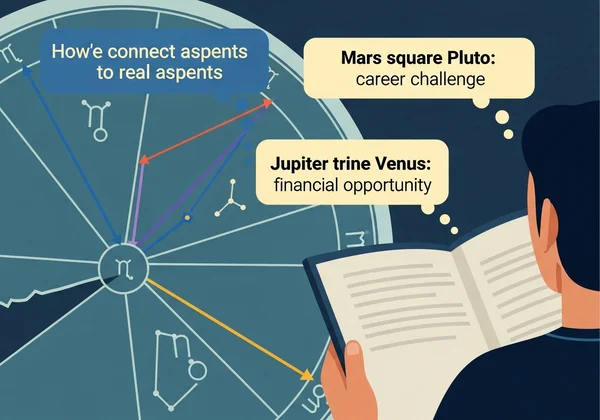
For instance, I once saw a client’s chart with a tense Mars square Pluto. Mars drives action. Pluto demands transformation. The square created a pressure cooker. Linking her 1st house (self) to the 10th (career), it signaled a huge workplace power clash that pushed for bold changes. It was a tough year, but it forced her to step into her own authority in a way she never had before. You can discover your themes by generating a chart that shows these connections clearly.
Practical Steps to Analyze Aspects with Your Solar Return Chart Calculator
Theoretical knowledge is great, but the real magic happens when you apply it to your own chart. A good calculator makes this process simple and insightful.
Locating Aspects in Your Generated Solar Return Chart
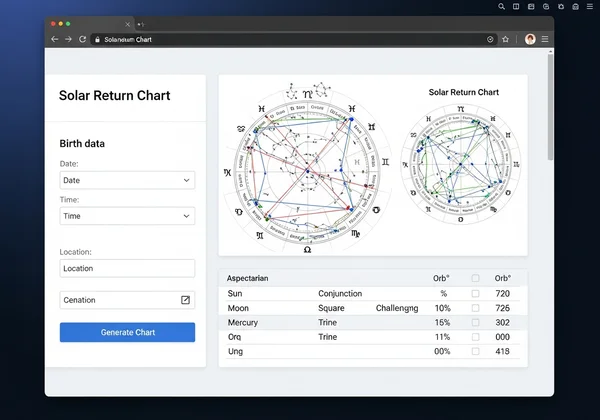
When you use an online tool like the one on our website, your aspects are displayed visually and often in a table. The lines in the center of the chart wheel represent the major aspects—red lines for challenging ones (squares, oppositions) and blue or green lines for harmonious ones (trines, sextiles). An aspect grid or table will list each aspect, the planets involved, and the orb (how exact the aspect is).
Integrating Aspect Meanings with Planetary Placements and Houses
Never interpret an aspect in isolation. House placement adds context. A Sun-Jupiter trine shines bright. In the 2nd house? Financial wins await. In the 9th? Get ready for travel or big learning adventures. The house placement tells you the specific area of life where the aspect's energy will manifest.
Beyond Major Aspects: Considering Minor Aspects and Orbs
For those who want to go deeper, astrology includes minor aspects like the quincunx (150°) and semi-sextile (30°). These add subtle layers of meaning, often pointing to areas that require minor adjustments. The "orb" of an aspect is also important—this is how close to perfect the angle is. A tighter orb (0-2°) means the aspect's influence will be much stronger and more noticeable throughout the year. Our personalized reports help you identify which aspects are the most significant for your year.
Empower Your Year: Decode Your Solar Return Chart Aspects
Think of your Solar Return Chart as your personal cosmic playbook for the year. The aspects are the key plays—the dynamic script that reveals your biggest challenges and brightest opportunities. By learning to read these cosmic conversations, you can navigate challenges with more confidence and seize opportunities with greater intention.
You no longer have to guess what the year holds. The answers are written in the stars, waiting for you to decode them. Are you ready to map your cosmic year? Generate your personalized Solar Return report now and unlock the blueprint for your journey ahead.
Frequently Asked Questions About Solar Return Chart Aspects
What is the most important aspect to look for in a Solar Return Chart?
While all aspects contribute to the story, pay close attention to aspects involving the Sun, Moon, and the ruler of the Ascendant. The Sun represents your vitality and main focus for the year. The Moon governs your emotional state, and the Ascendant ruler sets the tone for your annual experience. A challenging aspect to one of these points will be a central theme.
How accurate are Solar Return Chart aspects for predicting my year?
Think of your Solar Return Chart as an astrological weather forecast, not a deterministic prediction. It shows the energetic climate of your year—where the storms (squares) and sunny days (trines) are likely to be. It reveals potentials and probabilities, but your free will always determines how you choose to navigate the weather. It empowers you with awareness, not fate.
Can Solar Return aspects predict specific events like a new job or relationship?
Aspects are better at predicting themes and internal shifts than specific, concrete events. For example, a strong Venus-Jupiter aspect doesn't guarantee you'll meet "the one," but it strongly indicates a year where opportunities for love, connection, and happiness are abundant. It sets the stage, but you still have to play the part.
What's the difference between Solar Return aspects and Natal Chart aspects?
The difference is timing and scope. Natal Chart aspects are with you for life; they are the core dynamics of your personality. Solar Return Chart aspects are temporary, lasting only for the 12 months between birthdays. They describe the specific annual "flavor" or "lesson" you are currently experiencing.
Where can I find a free Solar Return Chart calculator to see my aspects?
You can get an instant, detailed analysis right here. Our website offers a free and powerful Solar Return Chart calculator that generates a beautiful, easy-to-read chart and provides interpretations to help you understand your unique aspects for the year ahead.