Solar Return Timing: How to Read Event Windows in Your Yearly Chart
June 17, 2026 | By Seraphina Sterling
Solar return timing is the art of reading a yearly chart as a living calendar, not as a fixed list of events. A solar return chart begins when the Sun returns to the exact zodiac position it held at birth, usually close to your birthday, and it describes the themes that may color the next personal year. If you want a clean starting point, you can generate a personalized solar return chart before you study dates, houses, or planet patterns. The most useful question is not "What will definitely happen?" but "When are certain themes more likely to become visible, and how can I respond with awareness?"

What Solar Return Timing Actually Means
Solar return timing connects the symbolic promise of the yearly chart with the rhythm of lived experience. The chart itself is cast for one exact moment: the Sun's annual return to its natal position. The interpretation, however, usually covers the birthday-to-birthday cycle that follows.
That distinction matters. The chart is not a stopwatch. It does not say that a relationship shift, career question, move, or personal breakthrough must arrive on one exact day. Instead, it gives you a map of themes. Timing work helps you notice when those themes may become louder, easier to observe, or more useful for planning.
For example, a strong 10th house or solar return MC can point toward visibility, professional direction, public roles, or long-term goals. That does not mean every 10th house year brings a promotion. It may mean the year asks you to take your work more seriously, make a public choice, review your reputation, or clarify what success means now.
Good timing interpretation stays humble. It combines the solar return chart with your natal chart, current transits, real-world circumstances, and your own choices.
How Long Does a Solar Return Take?
The exact solar return is brief: it is the moment the Sun reaches the same zodiac degree and minute as your natal Sun. Depending on the year and your location, that moment may fall on your birthday, the day before, or the day after.
The solar return chart built for that moment is usually read for about twelve months, from one solar return to the next. Many astrologers treat the weeks around the birthday as a transition zone. The month before the solar return can feel reflective, unfinished, or preparatory, while the month after may bring clearer signals about the year ahead.
If you are asking about solar return timing events, think in layers:
- The exact return marks the technical start of the chart.
- The birthday season often reveals the emotional tone of the year.
- The full chart describes the larger annual pattern.
- Repeated triggers during the year may activate specific themes.
This layered view is more useful than expecting one date to explain everything.
Start With the Chart's Main Timing Signals
Before looking for event windows, make sure you know what the chart is emphasizing. A browser-based solar return chart calculator can help you identify the Ascendant, house placements, angles, and planets in solar return without building the chart by hand.
The Solar Return Sun
The solar return Sun is the heart of the chart because the entire return is defined by the Sun coming back to its natal position. Its house often shows where identity, attention, vitality, and personal intention gather during the year.
A solar return Sun in the 4th house may highlight home, roots, family patterns, privacy, or emotional grounding. In the 7th house, it may bring partnership dynamics into focus. In the 10th house, it may emphasize direction, responsibility, leadership, or visibility.
Use the Sun's house as a timing anchor. When monthly transits, lunations, or personal decisions touch that same life area, the solar return Sun theme may become easier to recognize.
The Solar Return MC
The solar return MC is one of the most useful timing symbols for public life. It can describe the kind of growth you are trying to become known for, the career questions that matter, or the direction you feel called to refine.
If the solar return MC is emphasized by planets nearby, strong aspects, or contact with natal planets, pay attention to seasons when career, reputation, goals, or public responsibility become active. This can be helpful for planning launches, applications, portfolio updates, or conversations about long-term direction.
Still, read the MC as a focus point rather than a promise. It may describe ambition, visibility, or responsibility, but your choices and circumstances shape the outcome.
Active Houses and Angles
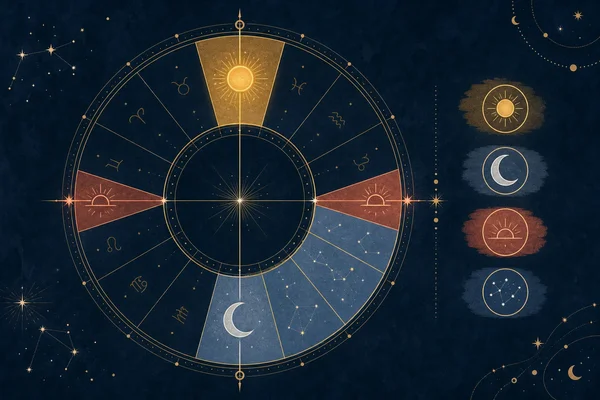
The houses that contain the Sun, Moon, Ascendant ruler, and clusters of planets usually deserve the most attention. Angular houses - the 1st, 4th, 7th, and 10th - tend to feel more visible because they connect with identity, home, relationships, and public direction.
If several planets in solar return gather in one house, that area may act like a stage for the year. If the Ascendant ruler lands there too, the theme may feel even more personal. The house does not force an event, but it shows where life may ask for more presence.
How to Connect Solar Return Timing to Events
Solar return timing becomes clearer when you look for repetition. A single symbol can be interesting. A repeated theme is more useful.
Watch for Repeated Themes
Suppose your solar return Sun is in the 9th house, the solar return Moon aspects Jupiter, and your natal chart is also receiving transits to education or travel houses. That repetition suggests a year when study, teaching, publishing, belief, distance, or perspective may matter.
If only one symbol points to the theme, keep it as a note. If three or more signals repeat, give it more room in your planning. This is one of the safest ways to use astrology for timing because it avoids overloading one placement with too much certainty.
Use Monthly Check-Ins
The easiest practical method is to review your solar return chart once a month. Choose the same day each month, then ask:
- Which house themes have been active?
- Which solar return planets have shown up through decisions or conversations?
- Did a birthday-season theme repeat?
- Are any current transits touching the solar return Sun, Moon, Ascendant, or MC?
- What can I plan, adjust, or observe next?
This turns the chart into a reflective planning tool. You are not waiting for the chart to "prove" itself. You are using it to notice patterns and make more intentional choices.
Compare With Real-Life Context
Solar return timing works best when it is grounded. If the chart highlights career but you are not currently seeking a new role, the timing may show up as a shift in responsibility, confidence, skill-building, or your relationship with ambition. If the chart highlights relationships, it may describe boundaries, collaboration, visibility with others, or the way you negotiate support.
Context keeps interpretation honest. A placement can describe a topic, but your actual life determines how that topic can appear.
A Practical Solar Return Timing Checklist
Use this checklist when you want to interpret a year without getting lost in every detail.

- Mark the exact solar return date and time.
- Note the solar return Ascendant and its ruling planet.
- Identify the Sun's house and the Moon's house.
- Look for planets close to the Ascendant, Descendant, IC, or MC.
- List the three busiest houses in the chart.
- Compare those houses with your natal chart.
- Watch for themes that repeat through transits or major life plans.
- Review the chart monthly instead of trying to settle the whole year at once.
This process also helps answer the common question of how to interpret solar return chart timing without turning every planet into a dramatic prediction. Start with the loudest signals, write down what they suggest, and then test the meaning through observation.
Common Timing Mistakes to Avoid
The first mistake is treating one placement as a certainty. For instance, Mars in the 7th house does not automatically mean conflict in every partnership. It may describe more direct communication, shared effort, desire, negotiation, or the need to act with others.
The second mistake is ignoring the natal chart. A solar return chart is temporary, but the natal chart is the foundation. When the solar return repeats or activates natal themes, the interpretation becomes more personal.
The third mistake is expecting the chart to replace judgment. Astrology can support reflection, but it should not make important decisions for you. If a choice involves health, safety, money, legal issues, or major commitments, use appropriate professional advice and practical information.
The fourth mistake is looking only for big events. Some solar return years are more about inner development, skill, rest, repair, or preparation. Those years can still be meaningful, even when they do not look dramatic from the outside.
Using Solar Return Timing for a More Reflective Year
Solar return timing is most helpful when it gives you language for the year you are entering. It can show where attention gathers, where growth may ask for patience, and where an event window might deserve practical preparation. It is less helpful when it becomes a rigid prediction system.
If your chart suggests a career-focused year, you might plan quarterly reviews, portfolio updates, or conversations with mentors. If it suggests a relationship-focused year, you might schedule honest check-ins, strengthen boundaries, or become more aware of collaboration patterns. If it suggests a home-focused year, you might prepare for changes in privacy, family rhythm, or emotional foundations.

The goal is not to control the year. The goal is to meet it with more awareness. When you are ready, you can explore your yearly chart with a calmer timing frame and use the results as a guide for reflection, planning, and thoughtful action.
FAQ
How long does a solar return take?
The exact solar return happens at one precise moment when the Sun returns to its natal zodiac position. The chart created for that moment is commonly read for the next twelve months, from one birthday cycle to the next.
Is it better to get a solar return reading?
A solar return reading can help if you want an experienced astrologer to synthesize the chart, but it is not required. Many people begin with a free solar return chart interpretation or calculator, then study the Sun, Ascendant, Moon, houses, and repeated themes.
What houses are most important in a solar return?
The most important houses are usually the ones connected to the Sun, Moon, Ascendant ruler, angular planets, and any planet clusters. The 1st, 4th, 7th, and 10th houses often feel especially visible because they are angular.
Can solar return timing predict exact events?
Solar return timing is better for reading themes and windows of emphasis than for naming exact events. It can suggest when a topic may become active, but it should be combined with transits, the natal chart, and real-life context.
What is the difference between solar return timing and transits?
Solar return timing reads the annual chart cast for the Sun's return. Transits track current planetary movement against your natal chart. Many astrologers compare both because repeated themes can make an interpretation more useful.
Why does the solar return MC matter?
The solar return MC can highlight public direction, career development, reputation, visibility, or long-term goals. It is especially useful when planets contact the MC or when the MC connects strongly with your natal chart.
How should beginners start with solar return timing?
Start with the Sun's house, the Ascendant, the Moon's house, and the busiest houses. Then keep a monthly journal of what themes actually appear. This creates a grounded feedback loop instead of forcing instant certainty.