When Is Solar Return? How to Find Your Exact Annual Return
September 18, 2026 | By Seraphina Sterling
Your solar return is not just a birthday mood or a general yearly horoscope. It is the exact moment each year when the Sun returns to the same zodiac degree and minute it occupied when you were born. That moment opens a new personal-year chart, which astrologers use to explore the themes, opportunities, pressures, and growth patterns of the next twelve months. If you are asking "when is solar return," the practical answer is usually near your birthday, but not always at midnight and not always on the same calendar day. A tool like an annual chart planning tool can help you locate the precise return and turn it into a chart you can actually read.
What a Solar Return Actually Times
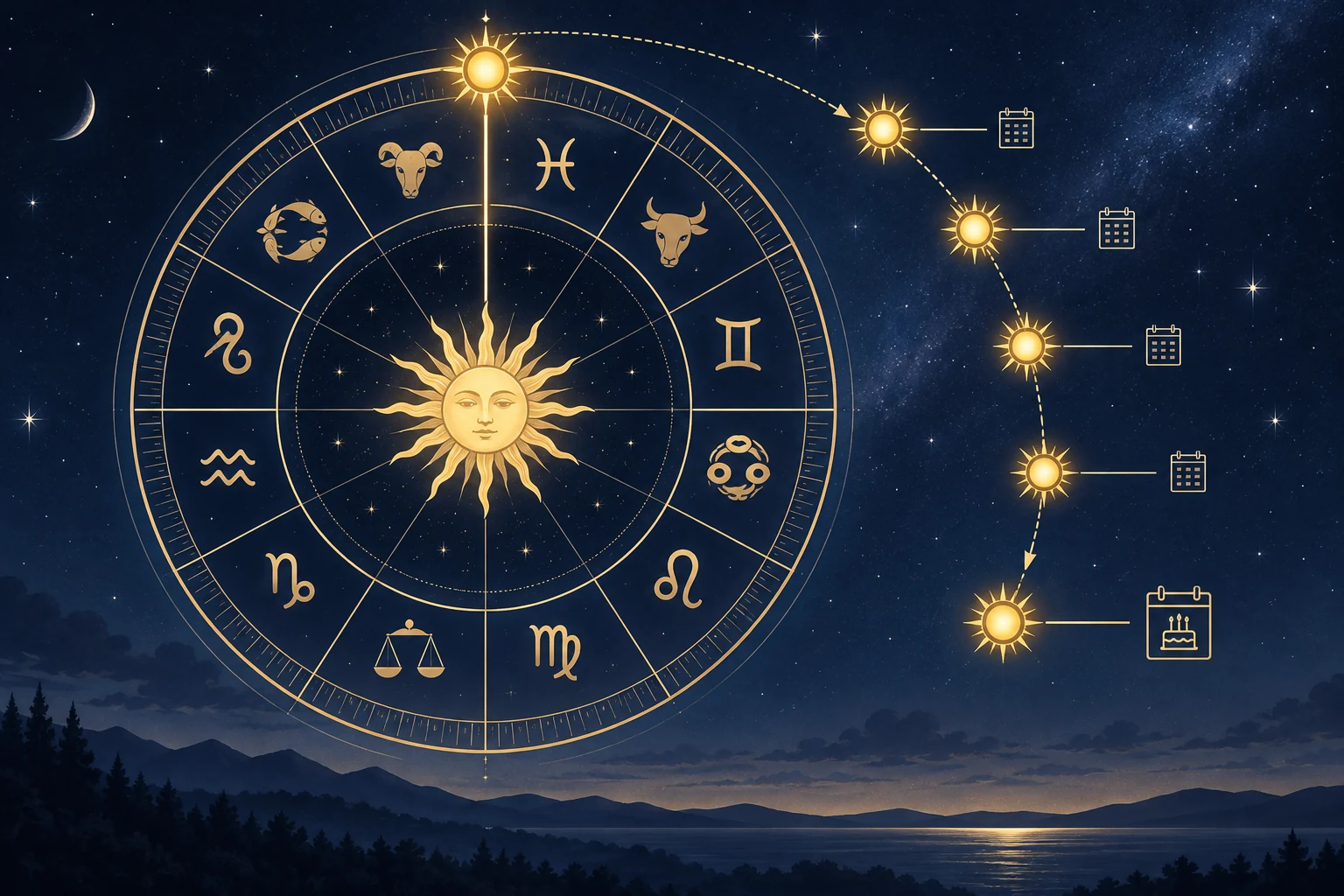
A solar return times the Sun's return to its natal position, not the whole day of your birthday. In a natal chart, your Sun is recorded at a specific zodiac degree. Each year, as the Sun completes its apparent cycle through the zodiac, it reaches that same degree again. The chart cast for that exact moment is called the solar return chart.
This is why "Is your solar return your birthday?" has a slightly layered answer. In everyday language, yes, it belongs to your birthday season and often happens on your birthday. In technical astrology, it can occur the day before, on the birthday itself, or the day after, depending on the year, time zone, and your location.
The reason is simple: the calendar year and the Sun's zodiac cycle do not line up as one neat 24-hour block. Leap years, time zones, and the precise solar position all matter. Someone born late at night may find that their return happens on the previous or following date in a different location. Two people with the same birthday can also have different solar return times because their birth times and places are different.
How Often Does a Solar Return Happen?
A solar return happens once every year. It marks the beginning of a new solar return year, which runs from one return to the next. If your solar return occurs on March 4 at 8:16 p.m. this year, that chart describes the symbolic year from that moment until your next solar return.
The return is not a prediction that cancels your choices. It is better understood as a yearly weather map. It can show where attention, motivation, friction, and support may cluster, but you still decide how to respond.
Why the Exact Hour Matters
The exact hour matters because the Ascendant, Midheaven, houses, and planet placements can shift quickly. The Sun will stay at the natal degree by definition, but the houses and angles depend on the time and location used for the chart. A few hours can move the Ascendant into a different sign or place planets in different houses, changing the emphasis of the interpretation.
That is also why an accurate birth time is important. If the birth time is approximate, the return chart can still be reflective, but the house structure may be less reliable. For beginners, it is fine to start with the larger themes, then treat exact house claims with more caution.

How to Calculate Solar Return Without Guessing
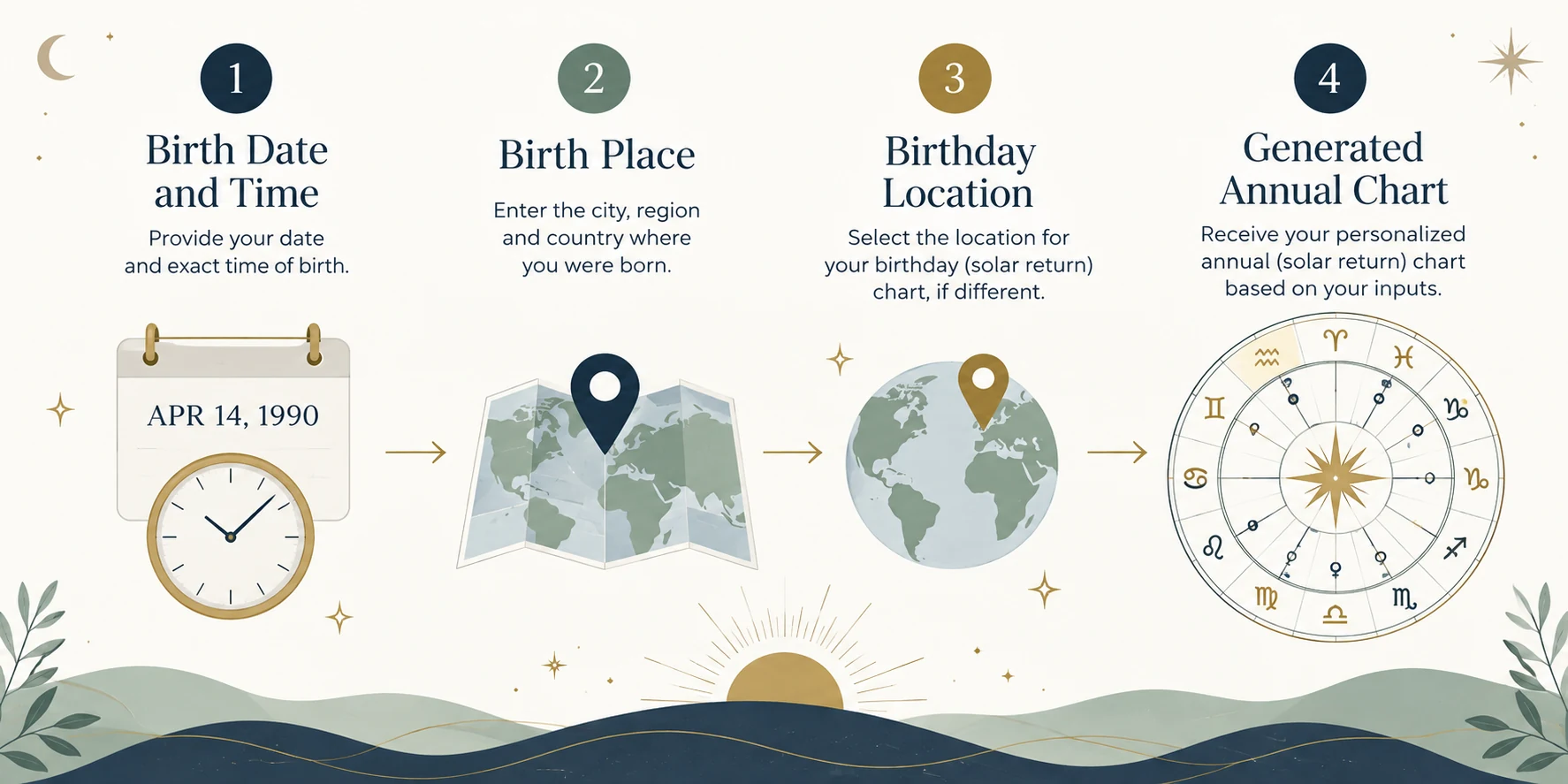
To calculate a solar return, you need four pieces of information: your birth date, your exact birth time, your birth place, and the location where you will be at the time of the return. For a solar return chart 2026, you also choose the solar year you want to examine, because the return will be calculated for that year's birthday season.
If you are using a free solar return calculator, enter your birth details carefully and choose the year you want. The calculator then finds the moment when the transiting Sun reaches your natal Sun's exact zodiac position. From there, it casts the chart for your return location.
Birth Place Versus Birthday Location
Your birth place anchors the natal Sun position. Your birthday location helps set the houses and angles for the return chart. This is why solar return astrologers often ask where you will physically be around your birthday, not only where you were born.
If you are traveling, use the place you expect to be at the actual return moment. If you are unsure, calculate both possible locations and compare the chart themes. The planet signs will be similar, but the Ascendant and houses may shift enough to change the annual emphasis.
What If You Search Astro Solar Return Tools?
Searches such as astro solar return, Astro-Seek solar return, free solar return chart Astrodienst, and solar return chart with interpretation all point to the same underlying need: people want both the timing and the meaning. A chart wheel alone can be hard to use if you do not know which pieces matter first. A solar return chart with interpretation can make the timing useful by explaining the Ascendant, Sun house, Moon house, angular planets, and major aspects in plain language.
When comparing tools, look for three basics. First, the tool should ask for a birth time, not only a birthday. Second, it should allow a current birthday location. Third, it should make the interpretation readable instead of overwhelming you with symbols.
How to Think About Solar Return 2026
Solar return 2026 does not mean one universal chart for everyone in 2026. It means your personal return for the birthday cycle that begins in or near 2026. If your birthday is in January, your 2026 solar return may cover most of 2026. If your birthday is in November, it may describe late 2026 through late 2027.
This distinction helps prevent a common mistake: treating the calendar year and the solar return year as identical. Your solar return year begins at your return, not January 1. For planning, it often makes more sense to review your return near your birthday and then translate the themes into seasonal or monthly intentions.
What to Do Once You Know the Solar Return Time
Once you know the exact time, the next step is not to read every symbol at once. Start with the structure that usually carries the most annual meaning.
First, look at the solar return Ascendant. It describes the tone of the year and how you may meet life during this cycle. The ruler of that Ascendant often becomes a key planet for the year, especially by house and aspect.
Second, look at the house of the solar return Sun. The Sun shows where vitality, identity, visibility, and conscious focus may gather. A 4th house Sun can make home, roots, and emotional foundations more central. A 10th house Sun can bring public direction, career visibility, or responsibility into focus.
Third, look at the Moon. The Moon can describe emotional needs, instinctive responses, and the kind of support you may seek during the year. Its house often points to where life feels most immediate.
Fourth, notice planets close to the angles. Planets near the Ascendant, Descendant, Midheaven, or IC tend to speak loudly in a solar return chart because they connect with the chart's strongest points.
Which Planet Should Not Be in the 1st House?
No planet is universally "bad" in the 1st house. A planet in the 1st house becomes visible and personal for the year. Mars can bring courage, impatience, and physical drive. Saturn can bring maturity, pressure, and self-definition. Neptune can bring imagination, sensitivity, and a need for clearer boundaries.
The better question is not which planet should be avoided, but how that planet asks to be handled. A challenging placement can still be useful when you read it as guidance rather than a fixed verdict.
What If the Solar Return Sun Is in the 11th House?
When the solar return Sun is in the 11th house, the year may highlight friendships, networks, communities, long-range hopes, audience building, or group participation. It can be a strong cycle for clarifying which communities energize you and which goals deserve a wider support system.
This placement does not require constant social activity. For some people, it marks a quieter reassessment of belonging: Who shares your future vision? Which collaborations feel alive? Where can your contribution matter beyond private life?
Keep Interpretation Grounded
Solar return astrology works best when it supports reflection and planning. It should not replace medical, legal, financial, or mental health advice. If a chart seems intense, slow down and translate symbols into practical questions. What needs attention? What can be prepared? Where would support make the year easier to navigate?

A Simple Solar Return Timing Checklist
Use this checklist when you want to find your return without overcomplicating the process:
- Confirm your birth date, exact birth time, and birth place.
- Choose the solar year you want to explore, such as your solar return 2026 cycle.
- Decide where you expect to be around your birthday.
- Calculate the exact return time for that location.
- Save the chart and note whether the return falls before, on, or after your birthday.
- Read the Ascendant, Sun house, Moon house, angular planets, and major aspects before moving into smaller details.
- Turn the themes into flexible planning questions for the year ahead.
If you want a simpler starting point, generate a browser-based solar return chart and use the timing as the doorway into interpretation. The goal is not to make your birthday feel fated. The goal is to understand the symbolic beginning of your personal year and use it as a reflective planning tool.
When someone asks "when is my solar return," the most honest answer is: near your birthday, at the exact moment the Sun returns to your natal Sun, calculated for the relevant year and location. Once you know that moment, the chart becomes much more than a date. It becomes a yearly map you can review, question, and work with at your own pace.
FAQ
When is solar return?
Your solar return is the exact moment each year when the Sun returns to the same zodiac degree and minute it occupied at your birth. It usually happens on your birthday or within one day before or after it.
Is your solar return your birthday?
It is connected to your birthday, but it is not always the same as the full calendar day. The exact solar return may occur the day before, on the birthday, or the day after, depending on the year, time zone, and location.
How often does a solar return happen?
A solar return happens once per year. It begins a personal solar return year that lasts until your next solar return.
How do I calculate my solar return?
Use your birth date, exact birth time, birth place, chosen solar year, and expected birthday location. A calculator then finds when the transiting Sun reaches your natal Sun's exact position and casts the chart for that moment.
Does my birthday location matter for a solar return chart?
Yes. The birthday location can affect the Ascendant, houses, and angles of the chart. If you travel around your birthday, the return location may shift the chart's annual emphasis.
What does solar return Sun in the 11th house mean?
It often points to a year focused on friends, networks, community, shared hopes, or future-facing goals. The full meaning depends on aspects, the Ascendant, the Moon, and the rest of the chart.